18th Nov 26
Finding the right video wall system to enhance your security operation
Video walls are an integral part of any security control room but constant technological advances and changing demands mean selecting the right one for your operation can be a minefield.
Ultimate Visual Solutions (UVS) is led by four senior colleagues who, between them, have more than 94 years’ combined Audio Visual, Control Room and Visual Solutions experience.
Here, managing director Steve Murphy guides you through the key points that should be considered when installing a new video wall.
Selecting the right video wall for any project, including control rooms or corporate and marketing display applications, is extremely important and many factors need to be considered.
Initially, the project budget is always a significant consideration. For example, LED video walls require a higher upfront investment than other large format display technologies.
But in return for that additional investment, you get a completely seamless display with no borders between individual panels, and LED technology typically offers an operational life that is around twice that of LCD equivalents.
It is, however, possible to make some compromises on overall LED video wall specifications that, when coupled with technology such as the UVS Lucidity video wall controller, still provide a high-quality and flexible display.
We work with a wide range of manufacturers so that we can offer the perfect displays to meet specific requirements, taking into account factors such as cost, size and the ability to offer seamless, 24/7 mission-critical operation.
Remember that space limitations and the mounting options available for the area may affect the size of a video wall. However, there are many different solutions available to meet specific requirements, including wall mounting (if the wall is strong enough to take the weight), floor-to-ceiling pole mounting and free-standing video wall structures.
UVS has also delivered many curved video wall installations to create a more dynamic effect.
A video wall will normally comprise multiple LCD video wall displays or multiple LED modules to create a single, large video wall display area.
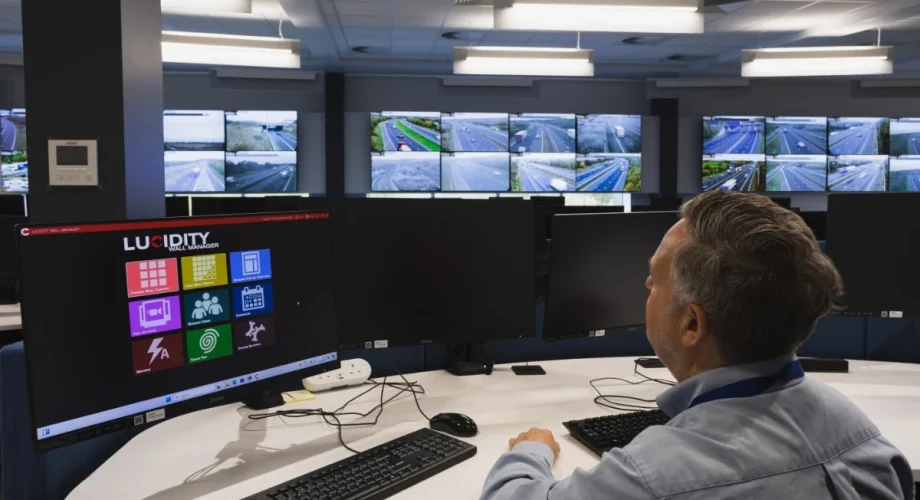
The specific project requirements will determine what types of data sources are required for display and control on the video wall. In security monitoring applications, for example, there may be a requirement for multiple CCTV camera feeds and other workstation data sources, such as access control and surveillance system data.
The information from a variety of data sources can be displayed simultaneously, and in stunningly clear and large formats, providing control room staff with important live operational data and a holistic overview of the assets they are monitoring.
At the heart of any effective and multi-functioning video wall, you need a video wall controller that fits your operational requirements.
It is connected in various ways to all the different data sources that you wish to display. These might include:
- Physically connected sources, such as a computer/workstation, laptop or TV tuner HDMI-type sources, allowing the content of a PC screen or TV feed to be displayed on the video wall, typically in a larger format than a single display.
- Network-connected web pages and URLs, which are becoming increasingly common requirements as more business-critical data moves to cloud-based platforms and monitoring dashboards.
- Network-connected CCTV and other IP video streams to monitor property, business premises, city centres and transport conditions.
- RSS feeds and message box data to allow up-to-date status information and important operational messages to be relayed via the video wall.
- Network-connected remote workstations and virtual machines. Increasingly, organisations are utilising virtual machines to increase processing capabilities and need to make the generated data available to the video wall for displaying important operational information.
The video wall controller software is where the real flexibility comes into play, allowing you to quickly display the sources you need to see, where you need to see them and at the required size.
It allows a single data source, for example a CCTV feed monitoring a traffic incident, to be displayed at large scale across multiple screens, providing more detail to control room operators who are monitoring and coordinating the response.
Equally, multiple data sources of different types can be displayed in single-screen areas for overview monitoring of applications. Any layout can be stored as a preset and quickly recalled from an associated desk-mounted touch panel at the press of a single button.
High-level video wall controllers, such as our own UVS Lucidity range, also allow integration with external systems, enabling video wall layouts to automatically change in response to external events or alarms.
KVM (Keyboard, Video, Mouse) solutions provide a method of controlling multiple computers with a single keyboard, video and mouse. In a control room environment, KVM solutions can be used to connect multiple users to many different computers, which can be located anywhere across a client’s estate, multiple estates or even global locations, providing efficient real-time control and collaboration.
Before investing in a video wall, you should request demonstrations to ensure you are getting exactly what you need.
We have demo rooms located around the UK and have also seen a huge rise in the number of remote online demonstrations we are running, as they offer an extremely effective way of showcasing the solutions we can provide.
The service, first launched at the height of the Covid pandemic, highlights the capabilities of products such as video walls and video wall controller technology, including the UVS Lucidity video wall controller and control software, live and in a real-world operational setting.
Finally, after investing in video wall technology, it is important to secure peace of mind that everything is covered in the unlikely event that anything goes wrong.
An annual support contract ensures that you are protected by scheduled preventative maintenance services and onsite support.
It also ensures priority investigation of any reported issues and provides the reassurance that trained engineers are available to assist by phone, remote access (where a suitable connection can be provided) or onsite support.
Scheduled preventative maintenance visits also ensure that all relevant firmware and software updates are applied to the system, helping to maintain optimum performance throughout its operational life.
For further information, contact us here, or call 01282 606525.
Share this article